You just tossed a stack of old bank statements into the recycling bin. No big deal, right? Actually, it is a very big deal. Identity thieves and corporate spies know exactly where to look for discarded documents. In California, where privacy laws are among the strictest in the nation, failing to destroy sensitive papers can lead to fines, lawsuits, and reputational damage. The solution is simple yet essential: consistent, thorough, and legally compliant shredding. This article explains exactly how to protect data with a California paper shredder, covering legal requirements, machine selection, and real-world best practices that go far beyond just feeding paper into a slot.
What Makes California’s Data Protection Laws Different for Paper Shredding?
California does not treat paper shredding as a casual office chore. The state mandates specific destruction methods under the California Consumer Privacy Act (CCPA) and SB 1386. These laws require businesses to shred documents containing personal information until they are “unreadable and undecipherable.” This is not a suggestion; it is a legal obligation with penalties reaching thousands of dollars per violation.
The CCPA and Physical Document Destruction
The California Consumer Privacy Act grants residents expansive rights over their personal data. While much of the publicity focuses on digital privacy, Section 1798.81.5 of the Civil Code explicitly covers physical records. Any business that owns or licenses personal information about a California resident must implement reasonable security procedures, including the destruction of paper records by shredding, erasing, or otherwise modifying them so the data is permanently unreadable. A standard strip-cut shredder often fails this test because strips can theoretically be reassembled. Micro-cut or cross-cut shredders are the safer legal bet.
SB 1386 and Notice of Breach
Senate Bill 1386 requires any California business that experiences a data breach involving unencrypted personal information to notify affected residents immediately. Paper records that are improperly disposed of and later retrieved by unauthorized parties count as a breach. If someone dumps your intact documents into a dumpster and a third party finds them, you may be legally obligated to send breach notification letters to every person whose data was exposed. This costs time, money, and trust. Proper shredding prevents this scenario entirely.
Medical and Financial Record Requirements
Beyond general privacy laws, healthcare providers governed by the Health Insurance Portability and Accountability Act (HIPAA) must follow the HIPAA Privacy Rule for paper records containing protected health information. Financial institutions must adhere to the Gramm-Leach-Bliley Act’s Disposal Rule. Both regulations require destruction that renders the information “unreadable or indecipherable.” California adds its own layer of enforcement through the Department of Justice, which actively prosecutes improper disposal of medical and financial records.
How Does a Paper Shredder Protect Against Identity Theft?
A paper shredder physically destroys the medium that carries your personal information, making it impossible for criminals to reconstruct documents containing Social Security numbers, bank account details, medical histories, or legal documents. This breaks the chain of access before thieves can exploit it.
Preventing Dumpster Diving
Dumpster diving remains one of the easiest ways for identity thieves to collect sensitive data. Thieves target commercial and residential trash bins looking for paystubs, credit card offers, tax returns, and pre-approved loan applications. A cross-cut shredder turns these documents into confetti-like particles that cannot be reassembled. Even if a thief collects shredded pieces, the time and effort required to reconstruct a single document is prohibitive.
Blocking Social Engineering Attacks
Some criminals do not need to dig through trash. They call businesses pretending to be vendors or clients, asking for “verification” of account numbers found on discarded documents. If you shred documents with customer account numbers immediately after use, you remove the ammunition these social engineers rely on. The data simply does not exist in readable form outside your secure systems.
Protecting Against Internal Threats
Not all data theft comes from outsiders. Employees, cleaning staff, or visitors may access documents left in recycling bins or unlocked cabinets. A clear shredding policy backed by accessible shredders in every department eliminates the temptation. When employees know that all sensitive documents must be shredded immediately, they develop a habit of protection that reduces internal risk dramatically.
What Type of Paper Shredder Meets California Compliance Standards?

California compliance requires a shredder that achieves at least a P-4 security level (cross-cut) for most business documents, with P-5 or P-6 (micro-cut) recommended for highly sensitive information like medical records or legal files. Strip-cut shredders typically do not meet the “unreadable” standard under California law.
Security Levels Explained
The DIN 66399 standard classifies shredders into seven security levels (P-1 through P-7). P-1 and P-2 are strip-cut and suitable only for general waste. P-3 is also strip-cut but slightly narrower. For California compliance, start at P-4 (cross-cut, particles roughly 4×40 mm). P-5 (micro-cut, 2×15 mm particles) and P-6 (micro-cut, 1×5 mm particles) provide dramatically better protection. Government and military applications use P-7. Invest in at least P-4 for general business use and P-5 for anything containing Social Security numbers or medical information.
Cross-Cut vs. Micro-Cut: Which One Is Right?
Cross-cut shredders cut paper into small rectangles. Micro-cut shredders cut paper into tiny diamond-shaped particles. Micro-cut shredders offer roughly 10 times more security than basic cross-cut models. However, micro-cut shredders produce smaller particles that take up more bin space and require more frequent emptying. For a law firm handling client financial data, micro-cut is non-negotiable. For a general office shredding routine correspondence, a high-quality cross-cut shredder at P-4 may suffice.
Capacity and Duty Cycle Considerations
A shredder’s sheet capacity and duty cycle determine how much you can shred before the motor needs to cool down. California offices often handle high volumes during tax season or quarterly audits. A 10-sheet cross-cut shredder with a continuous run time of 10 minutes works for light individual use. A 20-sheet micro-cut shredder with a 30-minute duty cycle suits a small team. For entire departments, consider a 40-sheet shredder with a 60-minute duty cycle or a central shredding station with multiple users.
Which Documents Absolutely Must Be Shredded in California?
Any document containing personally identifiable information (PII), protected health information (PHI), financial account numbers, or confidential business data must be shredded in California. The law does not distinguish between a sticky note with a password and a formal contract—both require destruction.
Financial Documents
Bank statements, credit card bills, loan applications, investment account statements, tax returns, W-2 forms, and payroll records all contain identifiers like account numbers, Social Security numbers, and income details. Shred these as soon as they are no longer needed for tax or legal retention purposes. The IRS recommends keeping tax records for at least three years, but after that, shred immediately.
Medical Records and Insurance Forms
Medical bills, insurance claims, prescription receipts, Explanation of Benefits (EOB) forms, and lab results contain diagnosis codes, treatment histories, and insurance ID numbers. Under HIPAA and California law, these documents require the highest level of destruction. Never throw medical records in the recycling. Use a micro-cut shredder rated at least P-5.
Business and Legal Documents
Contracts, client agreements, non-disclosure agreements, intellectual property filings, patent applications, and legal correspondence often contain trade secrets or client confidences. Shredding these protects you from liability and prevents competitors from gaining insight into your operations. Additionally, any document that contains a signature, date of birth, or driver’s license number should be shredded without exception.
Pre-Approved Credit Offers and Junk Mail
Credit card companies routinely send pre-approved offers that include your name, address, and credit score criteria. Identity thieves can activate these offers and open accounts in your name. Shred every pre-approved offer immediately. Also shred any junk mail that includes a barcode, QR code, or personal identification number, as these can be scanned and exploited.
How to Choose the Right California Paper Shredder for Your Business?
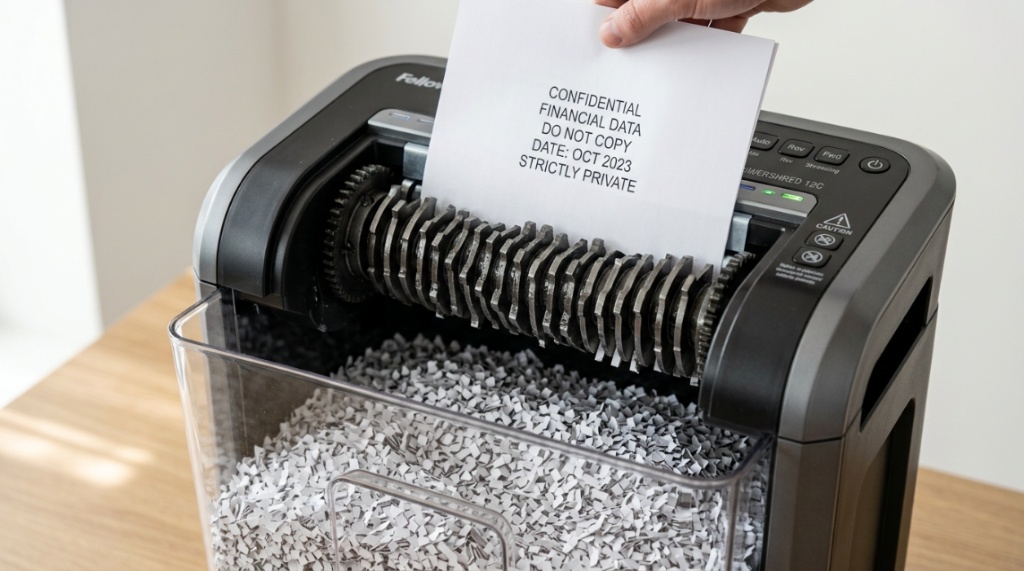
Choosing a shredder begins with assessing your document volume, security needs, and physical workspace. A small law firm has different requirements than a medical billing office or a real estate agency. Start by defining the highest security level you need, then match capacity and features.
Evaluate Document Volume Per Day
Count how many pages you shred daily. A home office might generate 50 pages per week. A busy legal practice might shred 500 pages daily. For volumes under 100 pages per day, a 10- to 12-sheet shredder with a 10-minute duty cycle works. For 100 to 500 pages, choose a 16- to 20-sheet shredder with longer run times. For 500+ pages, consider a high-volume shredder with a 40-sheet capacity and automatic oiling.
Consider Physical Space and Noise
Shredders range from desktop models the size of a trash can to industrial units on wheels. Measure your available floor or desk space. Also consider noise level measured in decibels. Some shredders operate at 55 dB (quiet) while others reach 75 dB (comparable to a vacuum cleaner). Open-plan offices benefit from quieter models to avoid disrupting work. Private offices can tolerate louder machines.
Look for Safety Features
Shredders are powerful machines with sharp blades. California workplaces must prioritize safety. Look for models with automatic shutoff when the bin is full, overload protection that prevents jams, and safety sensors that stop the blades if hands get too close. Thermal protection prevents motor burnout during heavy use. These features reduce downtime and protect employees.
For a curated selection of models that meet these exact criteria, explore our guide on California paper shredder data protection solutions tailored for various office sizes and security needs.
How to Set Up a Paper Shredding Policy for Your California Office?
A shredder alone does not protect data. You need a written policy that specifies what gets shredded, when, and by whom. This policy should be distributed to all employees, reviewed annually, and enforced consistently. Without a policy, shredding becomes inconsistent and unreliable.
Define “Sensitive Documents” Clearly
Your policy should explicitly list document types that require shredding. Include examples such as “any document containing a full name combined with a financial account number” or “any document with a medical diagnosis code.” Avoid vague language like “important documents.” Vagueness leads to confusion and mistakes.
Assign Responsibility and Schedule
Designate one person per department as the shredding coordinator. This person ensures shredders are emptied, maintained, and stocked with bags. Set a regular shredding schedule—daily for high-volume areas, weekly for low-volume areas. For documents that are highly sensitive, mandate immediate shredding rather than bin storage.
Train Employees Every Six Months
New hires need training on the shredding policy during orientation. Existing employees should receive refresher training every six months. Cover how to identify sensitive documents, how to use the shredder safely, and what to do if the shredder jams. Document attendance and keep training records as proof of compliance if ever audited.
Can a Paper Shredder Handle Electronic Media Like Hard Drives?
Standard paper shredders cannot handle hard drives, CDs, DVDs, credit cards, or USB drives. Attempting to shred these items can damage the blades and void the warranty. However, many industrial shredders designed for California offices include dedicated slots for electronic media.
Use Media-Specific Shredders
If your office disposes of credit cards, ID badges, or optical discs, purchase a shredder with a separate media slot. These slots use different cutting mechanisms that grind plastic and metal without harming the paper blades. Some models also shred staples and paper clips safely, but always check the manufacturer’s specifications.
Hard Drive Destruction Methods
Hard drives require specialized destruction. Degaussing (using a strong magnetic field) erases data, but it does not physically destroy the drive. Physical destruction via a hard drive crusher or industrial shredder is more secure. California businesses handling client data should contract with a certified e-waste recycler that provides a certificate of destruction for each hard drive.
Combination Shredders for Mixed Media
Some high-end shredders accept paper, credit cards, CDs, and staples in a single feed. These machines are ideal for offices that need to destroy multiple media types without separate devices. Check the security level for each media type—some combination shredders achieve P-5 for paper but only basic shredding for plastic. Verify compliance before purchasing.
How to Maintain Your California Paper Shredder for Long-Term Use?
Regular maintenance extends the life of your shredder and ensures consistent security. A poorly maintained shredder jams frequently, produces larger particles, and may stop working altogether during critical shredding sessions. Follow these steps to keep your machine running efficiently.
Oil the Blades Monthly
Shredder blades need lubrication to reduce friction and prevent dulling. Use specialized shredder oil—never use cooking oil, WD-40, or aerosol lubricants. Apply the oil across the full width of the paper entry slot, then run a few sheets of paper through to distribute it. For high-volume shredders, oil after every 30 minutes of continuous use or once per week.
Empty the bin before it overflows.
Overfilling the waste bin causes paper to pack tightly, leading to jams and motor strain. Empty the bin when it reaches two-thirds full. Check the manufacturer’s instructions—some models have sensors that prevent operation when the bin is full. Never press down on shredded material to make more room; this can push particles into the blades. Once you have securely destroyed your confidential documents, you don’t have to just throw the remnants away. You can actually repurpose the leftovers sustainably by adding paper shredder waste to garden soil to help boost your backyard composting efforts.
Remove Staples and Paper Clips (When Required)
While many modern shredders can handle staples and paper clips, not all can. Check your manual. If your shredder cannot handle metal, remove all staples and clips before feeding documents. Failure to do so can break the blades and require costly repairs. For offices that shred high volumes, consider a shredder designed to handle staples to save time.
Frequently Asked Questions
What is the minimum security level required for California compliance?
The minimum recommended security level for California compliance is P-4 (cross-cut). This produces particles roughly 4×40 mm, making reassembly impractical. For medical records or financial data, P-5 or P-6 micro-cut is strongly advised.
Do I need to shred documents that contain only my name and address?
Yes. Thieves can combine your name and address with other publicly available data to open accounts or file fraudulent tax returns. Shred any document that contains your name paired with any other identifying detail, even if it seems harmless.
How long should I keep paper records before shredding them?
General business records can be shredded after three years. Tax records should be kept for at least three years from the filing date. Medical records may require longer retention per state and federal laws. Consult a legal professional for specific retention schedules relevant to your industry.
Can I use a shredding service instead of buying my own shredder?
Yes, but you must hire a NAID (National Association for Information Destruction) certified service. These services provide locked bins, scheduled pickups, and certificates of destruction. Ensure the service uses cross-cut or micro-cut shredding and follows California disposal laws.
What should I do if my shredder jams?
First, unplug the shredder. Remove any visible paper from the entry slot. Use the reverse function (if available) to clear the jam. Never insert metal objects to pry paper loose. If the jam persists, consult the manual or contact the manufacturer.
Is it safe to shred credit cards and plastic ID cards?
Only if your shredder has a dedicated media slot designed for plastic. Standard paper shredders can be damaged by plastic. Check your shredder’s specifications before attempting to shred any plastic item.
Does California law require businesses to keep a shredding log?
While not explicitly required, keeping a shredding log is a best practice recommended by legal experts. A log should include the date, document types shredded, volume, and the name of the person who performed the shredding. This log serves as evidence of compliance during audits or legal disputes.
Conclusion
Protecting data with a California paper shredder is not just about buying a machine—it is about building a culture of security that meets the state’s rigorous legal standards. You must choose the right security level, identify every document that needs destruction, implement a clear policy, and maintain your equipment consistently. The laws in California are designed to protect consumers, and they place the burden of compliance squarely on businesses and individuals who handle personal information. By investing in a high-quality shredder, training your team, and following the guidelines outlined here, you significantly reduce the risk of identity theft, legal penalties, and reputational harm. Do not wait until a breach occurs. Start protecting your data today with the right shredding practices and equipment. Your clients, your employees, and your bottom line will thank you.